Monday, May 21, 2012

Senate Bean Soup

Over the years I spent considerable time in Washington DC. During some of my assignments  I had meals in the Senate's restaurant. One of my favorite dishes was Senate Bean Soup which has been served for at least the past 100 years.

The Senate website describes the history of this popular and unpretentious dish as follows:

Senate.Gov. The United States Senate


"
Senate Bean Soup
Senate restaurant staff preparing bean soup
Bean soup is on the menu in the Senate's restaurant every day. There are several stories about the origin of that mandate, but none has been corroborated.  
According to one story, the Senate’s bean soup tradition began early in the 20th-century at the request of Senator Fred Dubois of Idaho.  Another story attributes the request to Senator Knute Nelson of Minnesota, who expressed his fondness for the soup in 1903.
The recipe attributed to Dubois includes mashed potatoes and makes a 5-gallon batch.  The recipe served in the Senate today does not include mashed potatoes, but does include a braised onion.  Both Senate recipes are below.
The Famous Senate Restaurant Bean Soup Recipe
2 pounds dried navy beans
four quarts hot water
1 1/2 pounds smoked ham hocks
1 onion, chopped
2 tablespoons butter
salt and pepper to taste
Wash the navy beans and run hot water through them until they are slightly whitened. Place beans into pot with hot water. Add ham hocks and simmer approximately three hours in a covered pot, stirring occasionally. Remove ham hocks and set aside to cool. Dice meat and return to soup. Lightly brown the onion in butter. Add to soup. Before serving, bring to a boil and season with salt and pepper. Serves 8.
Bean Soup Recipe (for five gallons)
3 pounds dried navy beans
2 pounds of ham and a ham bone
1 quart mashed potatoes
5 onions, chopped
2 stalks of celery, chopped
four cloves garlic, chopped
half a bunch of parsley, chopped
Clean the beans, then cook them dry.  Add ham, bone and water and bring to a boil.  Add potatoes and mix thoroughly.  Add chopped vegetables and bring to a boil.  Simmer for one hour before serving.

While the above-listed recipes use navy beans, I prefer great northern beans. The difference has been described in eHow.com :

  • While both beans are light colored, the great northern bean holds its shape better than the navy bean, making it more suitable for dishes in which the cook desires the beans to hold their shape. It also cooks more quickly than the navy bean. However, soups made from the two beans are highly similar, typically featuring bacon or ham, onions, celery, carrots, garlic and sometimes tomatoes or pasta.

    My Version of the Senate Bean Soup 
    2 pounds of great northern beans
    2 quarts of water
    2 quarts of chicken broth
    4 cups of chopped left-over ham
    2 medium chopped onions
    1 cup chopped celery
    1 cup of sliced carrots
    1 teaspoon of salt
    1 teaspoon of pepper
    1/2 cup olive oil
    1 teaspoon garlic powder

    Rinse the beans well and place in a stockpot.
    Add the water and chicken broth and bring to a slow boil for 3 hours.
    Saute the onions in the olive oil in a pan. 
    Add onions and oil to the beans along with all the remaining ingredients.
    Take 3 cups of the mixture and puree in a blender, return the puree to the mixture. 
    Slow boil the mixture for an additional 30 minutes and stir well.


      Fiber and Water for Optimal Digestion

    A diet of bean soup is profoundly good for your digestive health. Bean soup provides insoluble fiber, which helps your gut to perform optimally. Bean soup's high water content keeps the fiber from gumming up the system, so to speak. Bean soup can also help to thwart overeating. Water-based foods have proved more effective than water alone for controlling hunger pangs and calorie intake. Soups and hot cereals are among the top choices for calorie-reducing diets.

    Some reasons for my time in Washington DC


    I did spend considerable time in Washington DC and found it an interesting place and the center of national and international discussion on a number of issues related to my research. The following are extracts are from my folder of press clippings.

    (1992). "Alan Hofmeister was awarded the Emmy from the National Academy of Arts and Sciences for Excellence in Children’s Programming for his role as Chief Scientist for the Mad Math Series on The Learning Channel (TLC). The television series was produced by Learning 2000, a subsidiary of the Discovery Channel."

    "(1984). "Alan Hofmeister was designated a Mary E. Switzer Scholar awarded by the National Institute on Disability and Rehabilitation Research (NIDRR)."
(1986). "Alan Hofmeister was invited by President Reagan to a White House reception to honor selected scientists who have made a contribution to the treatment of the handicapped."

(1981). "Alan Hofmeister was the Invited Keynote Speaker for the National Meeting of the Association of Media Producers, Washington, DC."

(1978-79). "Alan Hofmeister served as the elected President, National Association for Special Education Technology - Washington DC."

The Washington DC life was a little overwhelming for this fellow raised in Outback Australia. When offered a very well paid job in Washington DC, I politely refused and  happily returned to the more rural Cache Valley, Utah.


Sunday, May 6, 2012

Coffee in Food Recipes

Curry, Chili and Coffee


In previous postings there was an emphasis on low-cost foods. Those with limited money have learned to make maximum use of inexpensive meats and related sources of proteins. In different countries and cultures families have made tasty and healthy dishes with inexpensive and modest amounts of different meats. Two spices, curry and chili, help generate tasty meals with a modest amount of inexpensive meats.

Recently researchers have suggested coffee can reduce the risk of Alzheimer's. The May 7, 2012, issue of U.K. Mail reported:

Drinking coffee regularly can reduce the risk of Alzheimer's 'by boosting caffeine levels in the blood.'

* Volunteers who remained healthy had twice as much caffeine circulating than those who progressed to the early stages of dementia.

  • First direct evidence that coffee intake is associated with a reduced risk, or delayed onset, of dementia.
  •  
  • The findings, published in the Journal of Alzheimer’s Disease, support previous studies which showed drinking three cups of  coffee a day can significantly reduce the risk of this incurable illness. Researchers think caffeine may work by triggering a chain reaction in the brain that prevents the damage done by Alzheimer’s.
  •  Drinking coffee regularly can reduce the risk of Alzheimer’s by keeping caffeine levels in the blood topped up, new research shows. Scientists who tracked elderly patients over a four-year period found those with the highest levels of the stimulant in their bloodstream at the start of the study were less likely to suffer the brain-wasting disease.
  •  
    Volunteers who remained healthy had twice as much caffeine circulating in their systems as those who progressed to the early stages of dementia, according to researchers at the University of South Florida....... In a report on their findings the researchers said: 'Coffee would appear to be the major or perhaps only source of caffeine for such stable patients.
    This case-control study provides the first direct evidence that caffeine/coffee intake is associated with a reduced risk, or delayed onset, of dementia.'

    Other recent studies suggest a daily coffee can ward off depression in women and even slash the risk of a stroke by a quarter.

Increasing  Coffee in Food Recipes

While not that common, coffee in liquid or instant powder form is used as an ingredient in meat sauces and similar dishes. At this time, we suggest you avoid the decaffeinated coffee powder until researchers give us more information on the effect of decaffeination and the findings listed above.
  Many really enjoy chili and curry dishes. These are often made with left-over meats and vegetables and fruit and often made quickly. 

To help me prepare curry and chili dishes quickly I use curry and chili liquid mixtures with strongly brewed coffee as the base ingredient. 

Curry Mixture Ingredients


10 cups of strong brewed  coffee 
10 tablespoons curry powder - I prefer the Madras combination of curry spices
1 tablespoon of chili powder
4 packets of Equal 
2 tablespoons of Vegemite (optional) I buy mine in the USA at https://www.simplyoz.com/
1/4 cup Worcestershire Sauce 


Combine ingredients in a pot and simmer until there is a 20% reduction in the liquid.


Chili Mixture Ingredients


These are the same as the Curry Mixture, except replace curry with chili powder and chili with curry. 

Using the Mixtures


I store the curry and chili mixtures in half-gallon bottles so that I can shake them well before using the contents. Rather than throw out unused coffee keep a half-gallon jar nearby and collect the left-over coffee.

For mild curry or chili dishes I use 1/4 cup of liquid for each quart of dish content. Equal in the recipe is used instead of sugar and enhances the flavor of the major spice. 


See post "Outback Queensland Curry" Thursday, march 3, 2011 for information on a typical curry recipe.


See post "Sausage Gumbo," November 4, 2010. This is not a typical chili recipe but chili powder is the core spice.


Chili Legends  and Myths
(The following was included in an article by Linda Stradley in 2004.) 


There are many legends and stories about where chili originated and it is generally thought by most historians that the earliest versions of chili were made by the very poorest people. J. C. Clopper, the first American known to have remarked about San Antonio's chili con carne, wrote in 1926:


"When they have to pay for their meat in the market, a very little is made to suffice for a family; this is generally made into a kind of hash with nearly as many peppers as there are pieces of meat - this is all stewed together."


According to an old Southwestern American Indian legend and tale (several modern writers have documented - or maybe just "passed along"), it is said that the first recipe for chili con carne was put on paper in the 17th century by a beautiful nun, Sister Mary of Agreda of Spain. She was mysteriously known to the Indians of the Southwest United States as "La Dama de Azul," the lady in blue. Sister Mary would go into trances with her body lifeless for days. When she awoke from these trances, she said her spirit had been to a faraway land where she preached Christianity to savages and counseled them to seek out Spanish missionaries.


It is certain that Sister Mary never physically left Spain, yet Spanish missionaries and King Philip IV of Spain believed that she was the ghostly "La Dama de Azul" or "lady in blue" of Indian Legend. It is said that sister Mary wrote down the recipe for chili which called for venison or antelope meat, onions, tomatoes, and chile peppers. No accounts of this were ever recorded, so who knows? 


How Coffee Could Save Your Life

Yet another reason to indulge your caffeine addiction
Coffee
Daniel Leclair / Reuters
To hear most recent research tell it, coffee is a miracle drink. The magic beans will ward off skin cancer and Alzheimer’s, reduce heart failure and diabetes risks, heighten focus, and maybe even protect liver health. Oh, and decrease suicide risk, according to the newest study that validates our coffee addictions.
According to a study performed by the Harvard School of Public Health and published this month in The World Journal of Biological Psychiatry, people who drink two to four cups of java each day are less likely to commit suicide than those who don’t drink coffee, drink decaf, or drink fewer than two cups each day. The study followed over 200,000 people for at least 16 years. And it’s not just a weak link: the researchers found that the suicide risk was cut by around 50 percent for caffeine fiends.
This isn’t the first time that researchers have discovered that coffee and smiles might go hand-in-hand. A 2011 study found that women who drink coffee cut their risk of depression by 15 percent compared to those who don’t. Michel Lucas, the head researcher of the most recent study, told The Huffington Post that coffee addicts can thank caffeine for the good news. The drug may actually act like a mild anti-depressant by tweaking levels of happy hormones like serotonin and dopamine.
Of course, there’s plenty of research out there that doesn’t look so kindly upon coffee drinkers. Recently, the New Yorker published an article arguing that while coffee may heighten focus, that means it also puts a squeeze on creativity. And of course, coffee’s well-known negative effects like insomnia and disturbed sleep cycles still hold.
Regardless, we’ll raise our mugs to this most recent study for giving us one more validation for our vice.


Read more: http://newsfeed.time.com/2013/07/26/how-coffee-could-save-your-life/#ixzz2aK3i26mX


Saturday, March 24, 2012

Turkey Minestrone

Recipe: Turkey Minestrone

This recipe came from the summers I spent in New York teaching at Columbia University in the early seventies. Initially I was flattered by the appointment to teach at Columbia University, until I found that most faculty preferred to be elsewhere to avoid the heat and humidity of summer in New York. I had a modest apartment (modest means it was a room with a shared bathroom) on Amsterdam Avenue, two blocks from Columbia.

Amsterdam Avenue, New York 
Minestrone is an international favorite vegetarian soup. If you want to serve this tasty soup as a meal you may have to address the needs of the non-vegetarians. The addition of ground turkey provides a middle ground. The turkey is not serious red meat and still preserves the basic minestrone taste. This is a great end-of-Winter meal.

Ingredients

1- 1.25 pounds ground turkey
½ cup olive oil
1 bunch chopped kale or 2-3 cups shredded cabbage
4-5 medium potatoes chopped into one-inch cubes
4-6 stalks of chopped celery
4 medium carrots chopped into one-inch slices
2 bunches of chopped green onions
4 cups chicken broth
1 16oz. can Italian style diced tomatoes
2 chopped medium onions
2 16oz. cans of cannellini (white kidney) beans
2 teaspoons salt
1-teaspoon pepper
1 teaspoon Italian seasoning
2 teaspoons dried parsley flakes

Options: 2 cloves of garlic, minced. Pasta e.g. 2 cups elbow macaroni and delete 2 of the potatoes.


Directions

Cook and brown turkey and chopped medium onions with half-cup olive oil.
Mix all ingredients and bring to a slow boil for 15 minutes while stirring well.

Place in a slow cooker or in a 250-degree oven for 60 minutes.
Serve sprinkled with Parmesan cheese.

This will make a serious meal for eight people.

The West End Bar - History of University Student Unrest

While teaching at Columbia I spent time at the West End Bar, a hangout for Columbia students. You could always count on lively discussions. Wikipedia describes the West End Bar as follows:

The West End
In the early 1940s, in the formative days of the Beat Generation, students including Allen GinsbergJack Kerouac, and Lucien Carr spent hours at the bar discussing their studies and their futures. In the 1960s, the bar was host to student activists upset about racial discrimination in the area and US foreign policy regarding Vietnam. Mark Rudd, who led the Columbia branch of Students for a Democratic Society and was a prominent member of the Weather Underground after his expulsion from the university in 1968, 
spent time at the bar while a student.
After closing for a year and a half, it was bought in 1990 by Katie Gardner, a graduate of Columbia's School of Journalism. She and her family installed a back room for beer pong, a basement area for parties, and a side room for dancing, and the bar became popular, especially among university freshmen. It became notorious, however, for allowing underaged drinkers, with or without ID. However, the bar began to crack down on underage drinking since it was shut down by the police in February 2005.
One Columbia graduate noted:

Yale had its Maury’s, Harvard its Elsie’s … Columbia had The West End. It was the gathering point for me and my friends. It was the place to go after an evening in the library and certainly late on a Saturday night before crashing. It was where much of my College days happened, were planned and emerged, always with a fun tinge, over 15 cent beers.
For me, the “Wet End” was more than just another restaurant/bar. It had character. It was full of conversation — often far from Contemporary Civilization, the course, but very much my contemporary lifestyle. Geoffrey Thompson - Class of 1963.

In addition to the Italian Food of New York, I developed a great love for Hungarian food, particularly at the Green Tree Hungarian Restaurant at 1034 Amsterdam Avenue. Stuffed peppers are still a favorite dish of mine. This little Mom and Pop Restaurant closed in the mid eighties. What a loss - great ethnic food at a reasonable price. A favorite for Columbia students. A June 1982 review of the Green Tree, by the New York Times stated:

A friendly and convivial restaurant offering hot, lusty and well-seasoned four-course dinners with coffee for under $9. Reminiscent of the homey, Bohemian cafe-restaurants of Europe, the GreenTree is a favorite with students from Columbia and Barnard. Diners seated at oilcloth tablecloths are supplied with paper napkins and get familial concern from waiters and owners. Dishes that have held up over time are golden, aromatic chicken soup; cold beet borscht; potato pirogen, filled dumplings fried and topped with cool sour cream; stuffed roast chicken, beef or veal goulash. Beers and wines are moderately priced. 


Alan Hofmeister  - March 18,  2012


Thursday, November 3, 2011

Second World War Rissoles


How to make Second World War Spam rissoles:

During the Second World War Spam or similar "mystery meat,"or "bully beef," made up a percentage of the housewife's meat ration. It proved to be a very useful ingredient for quick and easy dishes like these rissoles. Cooks serving troops in the field used this recipe using much larger quantities.


For troops, these were a welcome change from MREs. Wrapped in waxed paper, 2 rissoles made a complete meal in the field. See the November 11, 2010 blog for a discussion of "Spam."


Ingredients
12oz corned beef or Spam finely diced
2 cups cold mashed potatoes
2 cups cooked mixed vegetables such as carrots, corn, peas, beans.
1 cup breadcrumbs
1 teaspoon salt and pepper
1 teaspoon of dried mixed herbs
2 tablespoonfuls of Worcestershire Sauce


Method

- Mix all ingredients
- Shape into 1/2 cup patties.
- Bake in a hot oven.
400 degrees for 40 minutes


Australian Troops at a World War II Jungle Kitchen and
 Aid Station


Too Light - By One Rissole: A World War I Observation
During the night before my Division (21st) attacked on October 4 1917, my unit was in the tunnel under the road at "Clapham Junction," near Hooge. Rations having failed to arrive, each man was given a rissole and a packet of chewing gum. We went over about 6 a.m., and despite severe losses, managed to push our line forward 1,300 yards. When we were back in "rest" dug-outs at Zillebeke, our officer happening to comment on our "feed" prior to the attack, my mate said : "Yus. Blikin' good job for old Jerry we did not have two rissoles a man - we might have shoved him back to Berlin!"
Comment by C. Hartridge, 92 Lancaster Street, S.E 1 from <www.firstworldwar.com> 


Australians were raised in culture where military duty was an expectation. Australians were continuously involved in wars some somewhere on the planet for the past 120 years. From the Boer wars in the late 1800's and early 1900's, the two world wars,  Malayan  Guerrilla warfare from 1947 to 1960, Korea, Vietnam and so on today in Iraq and Afghanistan . My military training started in high school and continued into officer training school where I served as a small arms instructor. I left as a senior sargent and headed for the USA.

Tuesday, November 1, 2011

Salmon Rissoles revisited

Salmon Rissoles Revisited

In the March 9, 2011, blog we featured salmon rissoles. Today, we revisit the salmon rissole recipe with some alternative approaches to the ingredients and the cooking procedures. Rissoles are one of the most common low-cost foods in many nations and have been popular under different names for hundreds of years. The rissole allows more expensive meat ingredients to be combined with lower cost and more available grain and vegetable ingredients, often the left-overs. Using bread crumbs made from stale bread is a common example of a left-over used in most rissoles. For a history of the rissole see post on Australian Outback Rissoles Monday, October 25, 2010.

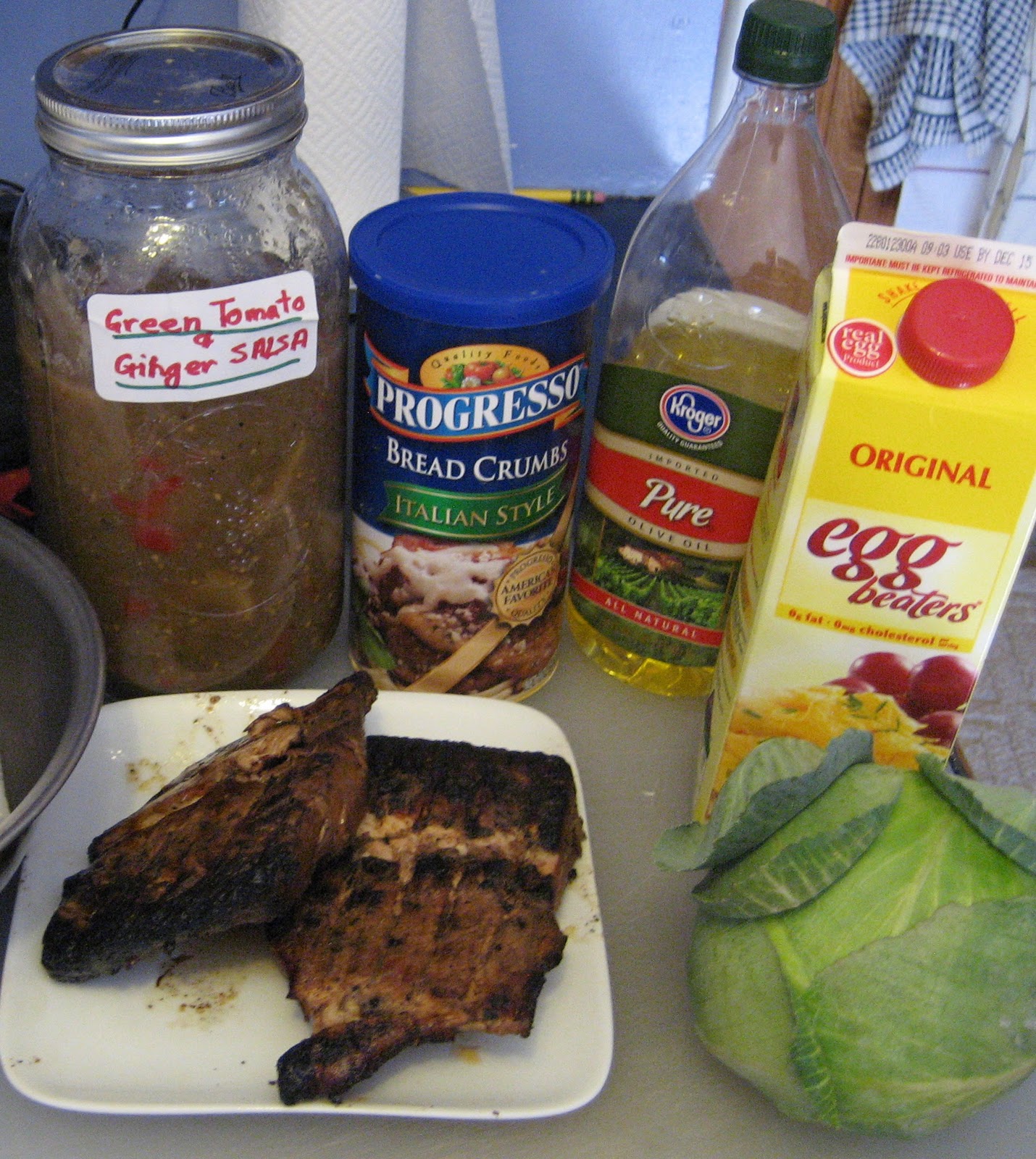
In the previous salmon recipe we used canned salmon as a way to reduce the cost of this tasty and most nutritious of foods. In recent months the price of salmon has dropped significantly. Lately, we have been buying three to four pounds of salmon and grilling and smoking the salmon. This left-over smoked salmon, marinated, grilled and smoked with several tasty grilling spices makes a great basic ingredient for salmon rissoles. One popular way to speed the preparation of most rissoles is to use salsa. Salsa with its tomato, onions and spices quickly adds several of the basic ingredients in most rissoles. In this recipe we used a green tomato and ginger salsa. Ginger was present in the earlier salmon rissole recipe. Onion is an important part of most beef pork and chicken recipes. Green tomatoes were common in many older rural recipes. In the days before the use of present garden pest control measures, green tomatoes were
 more common and ripened red tomatoes were often lost to the garden predators. Green tomatoes have just as many nutrients as the red ones.
 See the end of this blog for a green tomato and ginger salsa recipe.

Ingredients.

2-3  cups of crumbled smoked salmon
2 cups of breadcrumbs with 2 teaspoons of
 Italian seasoning or use Italian breadcrumbs
2 beaten eggs or one cup of Eggbeaters
1 cup of thinly shredded cabbage
1 cup of green tomato and ginger salsa
1/2 cup of olive oil
Crumble the smoked salmon and mix in a bowl with other ingredients except the olive oil. Select a muffin baking tray and place one teaspoon of olive oil in each cup of the muffin tray, Place a 1/2 cup of the mixture in each cupPreheat the oven to 400 degrees and bake for 30 minutes.


The present day baking pans, such as the one-cup muffin pans above, offer an alternative to cooks short on time. These new heavy non-stick  baking pans allow the cook to preheat the oven, place the mixture in the pan, and do other things, instead of monitoring and turning rissoles in a frying pan.

Green Tomato and Ginger Salsa

Initial Ingredients.
12 cups diced green tomatoes
4 cup diced onions
2 cups of diced red bell peppers
1 cup of finely chopped crystalized ginger
3 tablespoons of pickling salt
2 tablespoons of chopped or minced garlic
2 teaspoons of black pepper
1 teaspoon of ground cloves
2 teaspoons of ground ginger
1/2 cup of lime juice
1/2 cup of apple juice
2 cups red wine vinegar
1/2 cup balsamic vinegar


Later Ingredient: 1 cup of dried potato flakes


Bring all initial ingredients to a slow boil in an 8 quart pot while stirring well. Slow boil for at least 2 hours and reduce content by about 20%. Then add potato flakes and slow boil for 3-5 minutes to produce a salsa texture.

Bottle in one-quart bottles. This recipe produces a medium salsa. Use an an alternative to basic red tomato salsa.