Sunday, May 5, 2013

Whole-Grain Wheat Bread


Whole-Grain Wheat Bread 


This bread is 100% whole grain and very tasty as well as full of nutrients. Store-bought whole-wheat bread is mostly white flour with a modest amount of the whole grain. To get the complete whole grain, you may have to mill the grain yourself. First select the wheat. I use red wheat.


I find the best way to acquire the red wheat is in
45 lb. buckets that cost about 25 US dollars per bucket. Given the national  interest in emergency or "prepper" food supplies, these buckets are easy to find online or locally in many communities. I get mine from a "big box" local grocery store. I have a hand wheat grinder and an electric grinder. You have to be very hungry to use a hand grinder. The hand grinder will work in emergencies when the electricity has failed.


Ingredients


This will make two loaves.

A very basic bread recipe uses warm water,  yeast, and flour. To be more tasty, add some salt,  sweetener, and oil or butter. See the reference to "damper" at the end of this post.

I use:

4 cups of hot water, not boiling. I take it from the hot faucet in the kitchen sink. You need the warm water to make the yeast work. Boiling water poured on the yeast will kill live, active yeast. Ensuring a warm temperature for the yeast when Grandma Hofmeister was cooking was not a major concern in the Queensland Outback. If it was 105 degrees F. outside and the kitchen stove was burning wood, the temperature was great for keeping the yeast active.

1/2 cup of olive oil for the bread mixture, 1 tablespoon for rubbing the inside of each of the two baking pans, and 2 tablespoons for basting the crust of each of loaf of bread after it is cooked.

For the sweetener  I use a 1/4 cup of honey and a 1/4 cup of molasses, mixed.

1 tablespoon of sea salt

8 cups of whole-grain flour.

2 dry active-yeast packets. These sealed packets contain a tablespoon each. Using these sealed packets usually means the yeast is alive and active. When time is an issue the outback australians used self-raising ("self-rising" in Australian) flour. See damper recipes below.


Take the bowl off the mixer and include every ingredient except the flour and yeast. Stir with a large spoon. Add half the flour (about four cups). Place the bowl on the mixer and gently stir until the hot water is well mixed. Then add the yeast and keep mixing slowly. This will be a very sticky mixture. You need to add more flour slowly, about a half cup at a time. Stop adding flour and stop mixing when the mixture stops sticking to the mixing bowl. There should be very little flour left.

Take the mixing bowl off the mixer and cover with a paper towel and a small cutting board to hold the paper towel in place. Let the mixture rise for 45 minutes. The dough should have risen noticeably.

Place the bowl back on the mixer and mix slowly for about a minute. This should reduce the mixture. Remove the bowl from the mixer and place the dough on a whole-grain, flour-covered cutting board. Knead the mixture into a roll and cut into halves. Knead each half for a few minutes and place in a baking pan which has been rubbed inside with olive oil to prevent loaves from sticking to the pans.

Preheat your oven to 400, set back to 350 and cook the loaves for 35 to 40 minutes.

Remove loaves from the oven and baste the top of each loaf with olive oil. This will ensure the loaves do not develop a heavy dry crust that will limit sandwich making.

Immediately remove the loaves from the pans and set them out for at least 30 minutes before eating. After 60 minutes you may wrap each loaf with foil and store in a cool place, but not in a refrigerator. The refrigerator will change the texture. The loaves will dry out quickly if not wrapped in foil or waxed paper. Remember there are no artifical preservatives in these loaves, so enjoy the bread within a day or two. The bread is still quite tasty for a week if kept well wrapped in foil.


Some Great Additions - Apples and Raisins


If you wish to vary the basic recipe listed above, there are two great tasty and healthy additions, apples and raisins.  I prefer to add three cups of my bottled cinnamon apples for each loaf. Some will peel and chop the raw apples and add three cups of chopped apples and 3 teaspoons of cinnamon per loaf. To make the raisin loaves, add three cups of raisins per loaf. I like to soak my raisins in dark rum overnight. This is still a healthy addition. The alcohol evaporates during the cooking, but the great rum taste does not. These additions are included in the basic mixture before the yeast is added.


Damper - The Outback Bread

The Aussie-info web site Noted:

In colonial Australia, stockmen developed the technique of making damper out of necessity. Often away from home for weeks with just a camp fire to cook on and only sacks of flour as provisions, a basic staple bread evolved. It was originally made with flour and water and a good pinch of salt, kneaded, shaped into a round, and baked in the ashes of the campfire or open fireplace. It was eaten with pieces of fried, dried meat, sometimes spread with golden syrup, but always with billy tea or maybe a swig of rum.

Today it is made with milk and self-rising flour. Salt is optional.

DamperBUSH DAMPER

3 cups of self-rising flour
1/2 teaspoon salt (optional)
3 tablespoons butter
1/2 cup milk
1/2 cup water

Sift flour and salt into a bowl, rub in butter until mixture resembles fine crumbs.
Make a well in the centre, add the combined milk and water, mix lightly with a knife until dough leaves sides of bowl.
Gently knead on a lightly floured surface, and then shape into a round and place on a greased oven tray. Pat into a round 15-16 cm (6-6 1/2 inch) diameter.
With sharp knife, cut two slits across dough like a cross, approximately 1cm (1/2in) deep.
Brush top of dough with milk.
Sift a little extra flour over dough.
Bake in a hot oven for 10 minutes, or until golden brown.
Reduce heat to moderate and bake another 20 minutes.
Best eaten the day it is made.


Baking Bread in Tough Times

Given that we started with a reference to emergency food preparation, all the above-listed suggestions for bread making can be done without the typical home oven, be it gas or electric. You will need a 12-inch Dutch Oven (in Australia we call them Camp Ovens). The 12-inch Dutch Oven is the perfect fit  for the standard bread loaf pan.


The following photo from www.aussiecampovencook.com says it all. If you use a smaller 8-inch Dutch Oven then the Dutch Oven would serve as both the loaf pan and the oven.


Part 2 is the next post - What to do with old dry bread?


Friday, May 3, 2013

Meat Pies


Meat Pie Filling.  

1/2 cup olive oil
1 1/2 lbs lean ground beef
1 1/2 lbs lean ground turkey
6 bacon slices - thick and peppered - cut into 1 inch pieces  
1 can condensed cream of Mushroom soup with garlic
1 can condensed French onion soup
2 cups chopped carrots
1 can peas
2 cups of chopped asparagus
1 can diced Italian tomatoes
2 teaspoons salt
1 teaspoon pepper
2 tablespoons Worcestershire Sauce
2 teaspoons dried basil
1 teaspoon garlic powder


Brown bacon in a large frying pan with olive oil.
Add beef and brown.
Add turkey and brown.

Add rest of ingredients, stir well and bake for an hour at 250. Leave lid off to reduce water content and thicken the mixture. If there is too much liquid in mixture, add two tablespoons of potato flakes.

This should make at least 8 small (mini) pies or two large meat pies. This recipe was designed to taste great and be more healthy than my usual meat pie recipes.


I found the following mini pie maker the best and fastest way to make a wide range of meat and fruit pies. The pie maker is typically available for about 80 US dollars online through folks like Amazon.


Breville BPI640XL Personal Pie Maker


  • Four pie molds with a 4-inch diameter
  • Edge crimper seals the pie with decorative trim
  • Locking latch
  • Easy clean non-stick surface
  • Included accessories: pastry cutter and pastry press


I do not usually endorse cooking appliances, however this brand has an Australian history.
Breville is a maker of small kitchen appliances, founded in Sydney, Australia, in 1932. They created the original sandwich toaster. The product was a huge success upon its launch in Australia in 1974, selling 400,000 units in its first year and making the Breville brand a household name in Australia. Soon after, the Breville toasted sandwich maker was launched in New Zealand and Great Britain where it met with similar success. The name became synonymous with such devices – to the point where “Breville” has become the generic word for a sandwich toaster, and often the toasted sandwich itself, in much the same way that “Hoover” is associated with the vacuum cleaner.

If you do not have this Breville pie maker you would bake the typical 9 inch pie at 400 degrees for about 40 minutes.  Given that small pies are a very portable food item and often spend considerable time out of a refrigerator before eaten, make sure the pie mixture is well cooked before it becomes a part of the pie.

For related posts see:

a. The Pie Iron Meat Pie - Dec. 24 2010.
b. Cornish Pasties - Oct. 31 2010.

My first experience in the making of meat pies was helping Grandma Hofmeister in her wood cooking stove kitchen in outback Queensland. The hand turned meat grinder was set up on the kitchen table and grandma collected all the beef related leftovers and I operated the grinder to generate the "minced" beef that went into the meat pie mixture. The house had a wood stove, no electricity and no indoor plumbing.


My thanks to my friend Chad for helping in the field testing of recipes. Chad also supplied the photo of the pie and peas.

Sunday, February 24, 2013

Whole Wheat Banana Nut Bread

Whole Wheat Banana Nut Bread


This is one very healthy recipe.

Ingredients

8 large overripe bananas. Roast the bananas if not overripe.

1 cup olive oil

2 eggs

1 cup milk or soy milk

2 cups whole wheat flour

1 cup plain flour

1 cup self-rising flour

1 cup ground flax seed

1 teaspoon baking powder

1 teaspoon baking soda

1 teaspoon salt

2 cups raisins

1 cup of nuts, e.g.,  pecans or macadamias

2 cups banana chips (dried banana slices)

1 cup of artificial sugar

Instructions


Roasting bananas will make them easy to mash if they are not overripe. They still need to be sweet and ripe. Place the bananas on a baking pan. Cook for about 15 minutes at 400 degrees until the bananas start to turn black. Allow the bananas to cool a little and then peel and mash.


 Place all the ingredients in a bowl and  mix well.  Line the inside of three loaf pans with foil and place a tablespoon of olive oil in each of two loaf  baking pans.

Cook for about 40 minutes at 400 degrees.  Cook until a toothpick in the center of the bread comes out clean.


A thick slice served with french vanilla ice cream makes an excellent desert. Slices with some butter make an excellent breakfast if you have run out of time.

Queensland: Home of the Macadamia Nut.


One of my delights as youngster growing up in Queensland was to climb my grandaunt Nan's Bauple Nut tree and harvest the nuts. The scientific name of this nut is the Macadamia Nut. It has been noted that:


Macadamia nuts are closely associated with Hawaii, and for good reason. Hawaii is the largest exporter 

of macadamia nuts, providing ninety-five percent of the world's crop. Yet this buttery-tasting nut is 

native to Australia and comes from a tree that was originally grown for ornamental purposes.

 The tree was introduced to Hawaii in 1880 where it thrived in the tropical environment.

 California now also produces a sizable macadamia nut crop. 


For some the Macadamia Nut has magical properties:


Macadamia is originally an Australian plant from which the nut is derived for extracting oil. This nut oil is natural and has plenty of benefits in every drop. It has enormous utilities in daily lives where it is preferred over any other cooking oil. It has diverse therapeutic uses in maintaining good health. A huge range of skincare and hair care products are made from it.


The ground flax seeds in this recipe also have healthy properties:


Flax seed, also known as linseed, is one of the ancient cultivated crops since Mesopotamian times, grown for its oil seeds, and fiber. The chewy seeds are packed with full of nutrients, omega-3 fatty acids, antioxidants, minerals, and essential vitamins. Off late, nutritional and health benefits of flax have widely drawn the attention of nutrition researchers as well as health enthusiasts alike across the planet.


Wednesday, December 19, 2012

Rum Rasin Ice Cream

Rum Raisin Ice Cream


This is my favorite ice cream. In Utah it is very rare to get this flavor at the local ice cream vendor. Clearly, the local religion did not have "rum raisin" as a flavor of choice for their children.

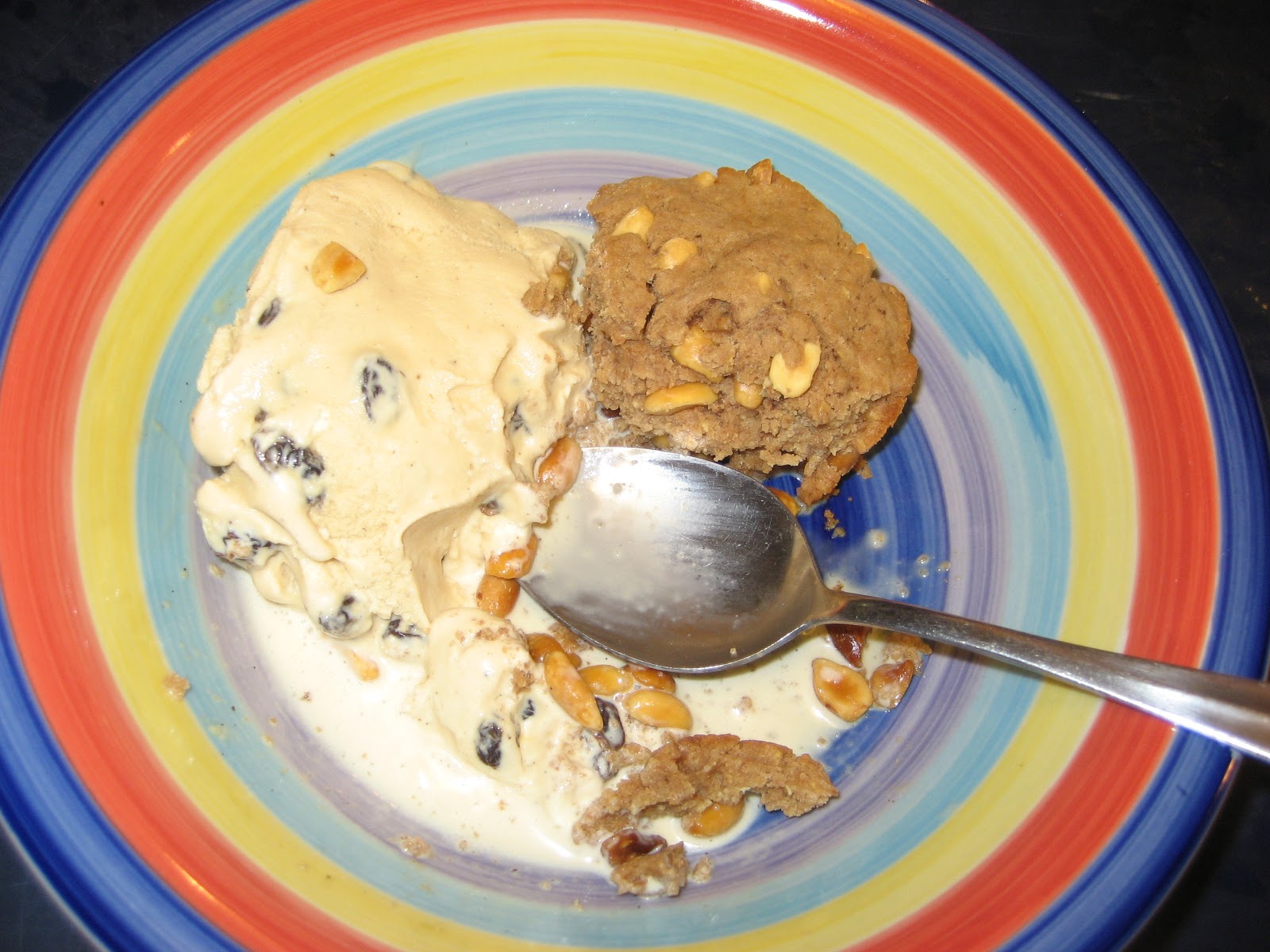
This is a very simple approach to the recipe. Take the best available vanilla ice cream, mix in rum-soaked raisins and refreeze. (In the photo above, I give credit to photographer Penny de los Santors for the most tasty of photos ever.) The rum-flavored fruitcakes made by my grandmother made me a fan of the rum raisin flavor. A bottle of Bundaberg Rum was the only alcoholic beverage in my grandparent's home, and it was kept in a dark, secret place in the pantry.


Ingredients

1 quart of raisins. The typical box of 24 oz. raisins is a little over a quart

1 cup of dark 70-proof rum

2 quarts of vanilla ice cream (French vanilla is my preference)


First, place the raisins and rum in a half-gallon canning jar and let the mixture sit for a week. I turn the bottle over every day to help the mixing process. Most of the rum will be absorbed by the raisins. If you do not want to wait for a week, adding a little more rum and letting the mixture sit overnight in a sealed container will work.

Place the raisins and ice cream in a bowl and mix wel as the ice cream starts to get soft. Do not let the ice cream melt completely. Place the mixture in a sealed bowl in the freezer. The rum raisin ice cream can be served next day.


                       Our favorite dessert: rum raisin ice cream and Gran's peanut cookies.


The Bundaberg Rum I remember from grandma's cooking has a long and interesting history. Some of my mother's relatives raised sugar cane close to the town of Bundaberg. My grand uncle, Horsley Pashly, owned a sugar cane farm near Bundaberg. I visited the farm on several occasions as a young teenager. Uncle Horsley took considerable time to explain sugar cane farming. He also introduced me to one of the strangest ecological disasters in Australian history, the cane toad.

The Australian Museum reported:
"The natural range of Cane Toads extends from the southern United States to tropical South America. They were deliberately introduced from Hawaii to Australia in 1935, to control scarab beetles that were pests of sugar cane. .....Cane Toads are considered a pest in Australia because they:
Poison pets and injure humans with their toxins; Poison many native animals whose diet includes frogs, tadpoles and frog's eggs; Eat large numbers of honey bees, creating a management problems for bee-keepers; Prey on native fauna; Compete for food with vertebrate insectivores such as small skinks; May carry diseases that can be transmitted to native frogs and fishes."

 The sugar from the sugar cane was produced locally in the Bundaberg area and the byproduct was molasses, which was considered a waste product. In 1888, the local sugar producers combined their resources and started the Bundaberg Rum Distillery as a way to make money from the molasses. This new industry was a success. The patrons are often called "Bundy" drinkers. These patrons have a rowdy reputation in some circles. One recent Wikipedia observation stated:

"Bundaberg Rum has been labelled the drink for yobbos, after some bars reported that 'bundy drinkers are a lot louder, and more disruptive than other patrons.' In 2005, four bars in Brisbane banned the rum products, claiming it makes drinkers aggressive and attracts the wrong crowd."

"Yobbo" is Australian for the USA term "redneck."

Uncle Horsley died in 1982. In checking some of the facts on the Pashley family I came on the following news summary from July 1892. The following depressing series of events generates respect for the daily dangers our pioneers faced. The four-year-old Sydney Pashley was certainly a relative of Uncle Horsley, who was born in 1904.


Taken from The Queenslander: Saturday, July 30, 1892
Queensland News
:
Herberton, July 26
"Michael HICKER, a stream tin miner, from Coolgar, left Herberton with his mate on Saturday evening on his way to camp, and when a short distance out on the Watsonville-road he was thrown from his horse, sustaining a fracture of the base of the skull. He was at once taken to the hospital, but died soon after admission.
Don't know where the following happened, paper damaged, in Qld though.
Mrs. Tremble, wife of a carter and wharf lumper, cut her throat this morning with a razor. She made two deep cuts into the wind-pipe, which bled profusely: and she is in a critical condition, owing to the blood suffusing the lungs. The cause of the attempted suicide was melancholy, arising from her being in an almost destitute condition, and a recent accident to one of her children."
------
Rockhampton: July 22,
"A young man named Richard SEALY, a son of ex-Constable SEALY, died last night from the effects of injuries received through a collision with another horseman at the racecourse on Thursday."
-------
Fatal Accidents at Bundaberg, July 25
"Two fatal accidents occurred on Saturday. A child named Sydney PASHLEY, 4 years old, was run over at North Bundaberg by a bullock dray, its head being severed from it's body.
At Fairymead a workman named Conrad RODEGER fell into a tank of boiling juice. He got himself out, but was fearfully burnt. He was removed to the Bundaberg Hospital, where he expired in fearful agony on Saturday afternoon.
Another fatal accident occurred to-day. A well known farmer named Joseph NEWELL, of Kalkall, was leading a horse which had been newly broken in to harness, when the horse bolted and threw him under the dray, the wheel of which passed over him, killing him instantly, his neck being broken."
--------------
The "tank of boiling juice" responsible for the death of Conrad Rodeger was almost certainly a part of the manufacturing of sugar from the sugar cane.


Tuesday, December 18, 2012

Gran's Peanut Cookies


Gran's Peanut Cookies


In my late teens I was fortunate enough to be welcomed into the Mavor family of Beaudesert in southern Queensland. The younger son, Ian, and I climbed many mountains together. His mother, Agnes, always made me welcome at the family dinner table if I was in the area. Gran, as she became known to children and grandchildren, always had her peanut cookies available ("peanut biscuits" in Australia). In her last years, Ian asked Gran to share her recipe for the "Peanut Biscuits."

In the photo below at a Mavor multi-generational meeting Agnes is standing third from the right with Ian on her left.


Gran's Original Recipe

Ingredients

1/4 pound of butter or margarine

1 teaspoon of Bourneville Cocoa

1 cup of sugar

1 pinch of salt

Vanilla essence drops

1 egg

1 cup of self-raising flour

1 cup of small unsalted peanuts that have been browned and skinned


Mix the ingredients well. Place scoops of the mixture on a baking tray and cook until the desired level of brown is reached.


Al's Adaptions to Gran's Original Recipe

Over time I have made a few adaptions, but the taste has not changed.

Ingredients

First, I doubled the mixture. The cookies never lasted long, and if they did, they kept well in a sealed container.

1/2 pound of non-fat margarine

1 level tablespoon of Hersey's Cocoa

2 eggs or a cup of Egg Beaters

2 cups of artificial sugar

1 teaspoon of vanilla extract

2 cups of self-rising flour. (Australians prefer self-raising flour.) If you want to use plain flour, add a level teaspoon of baking powder.

2 cups of small, unsalted, baked peanuts. I prefer the small peanuts to chopped peanuts. Most large grocery stores carry the small, unsalted, baked peanuts in bulk.

Mix all the ingredients well. I use a 1/4 cup measure to scoop the mixture and either bake as cookies or mini-muffins. Coat the baking sheet or muffin pan with olive oil.


Bake at 400 degrees for 10 minutes. Let sit for at least 30 minutes before eating, if you can protect them for that long.

The mini-muffins are great as a desert with ice cream. Judy and I prefer the mini-muffins with rum-rasin ice cream. This is the greatest cookie with the greatest ice cream.


Ian on one of our many backpacking adventures in the mountains of southern Queensland.


I consider my adoption by the Mavor family in my late teens one of my greatest privileges and learning experiences at a time when I was setting life-long directions.


Saturday, December 15, 2012

Corned Beef and Cabbage Soup

Corned Beef and Cabbage Soup


Corned Beef has nothing to do with corn, while it does relate to "grain." The link is to a grain of salt. "Corn is the Old English word for grain or pebble. Corned beef is salted beef and was a major commodity in 18th and 19th century trading between Ireland and England. Unfortunately, the Irish people did not benefit much because most of the beef was raised on land the English nobility had taken over in Ireland. As a child taken to the local butcher by my grandmother in a little town in outback Australia, I watched the corned beef being made as the butcher hand-pumped brine solution into the slabs of beef with a foot long needle. The end product was important at a time when there was little electricity and home refrigeration, and the non-perishable nature of salted meat made corned beef an important part of the diet. The corned meat also came in canned form such as Spam or "Bully Beef."

Ingredients


 2 1/2  pounds of corned beef. Chop the beef into 1 inch pieces. This should serve 8.

1 medium to large head of cabbage, cored and shredded.

2 large onions, diced

6-8 ribs of diced celery, include the leafy tops

1/2 cup of olive oil

6 cups of diced carrots

1 teaspoon salt

1 teaspoon pepper

8 cups of chicken or beef broth

4 cups of cooked rice. The original Irish recipes probably used barley instead of rice so that is an option.

3 cans of 16 oz. diced Italian tomatoes

1/4 cup of Worcestershire Sauce

2 12 oz. bottles of beer. I prefer Guinness Stout.

If the corned beef brisket came with a packet of spices use them and reduce the spices listed above by half. The spices are basically pickling spices. Typically they include:

•8 allspice berries
•1 teaspoon black peppercorns
•2 bay leaves, crumbled
•2 fresh thyme sprigs or about 1/2 teaspoon dried leaf thyme


Heat the olive oil in the soup pot and add the onions and beef. Stir for five minutes and add every thing except the broth, stout and tomatoes. Stir for another five minutes and add the broth, stout beer and tomatoes. Slow-cook the soup for at least 30 minutes.

To make a complete meal, serve with substantive slices of garlic bread. See the garlic bread recipe in the previous posting.

In the Irish pubs I used to frequent in Boston and New York, this was often the "Friday Night Special" and was served with bread at the bar. No St. Patrick's Day bar celebration was held without Corned Beef and Cabbage Soup on the menu.


Friday, December 14, 2012

Garlic Toast


Garlic Toast


A hearty soup can become a complete meal if it is accompanied by a substantive slice of garlic toast. The secret to a "substantive" slice of garlic toast is a tasty, large amount of cheese on a thick slice of bread. Thick slices of wheat bread or sourdough bread are excellent. A wimpy slice of standard white bread will not make a meal.


For two slices of bread, mix the following:

1 cup of grated Cheddar - I  prefer medium Cheddar. The Pepper Jack and Medium Cheddar is my favorite combination. You may  prefer another combination.

1 cup of grated Pepper Jack cheese.

4 tablespoons of Garlic Olive Oil  (olive oil with 1/2 teaspoon of garlic powder will work)

a dash of salt and pepper to taste

Mix these ingredients well.

Toast the bread lightly, then add the cheese to the lightly toasted bread and return to the toaster. Continue to toast until the cheese starts to brown. Remove and serve.

Do not overdo the olive oil or it will pool up in the bottom of the toaster or oven and could catch fire. You could toast the bread then place the bread and cheese mixture on aluminium foil and place back in the toaster or oven.

The soup above is a ham and bean soup with chopped steamed potatoes, carrots and asparagus pieces. The beans are Great Northern Beans. See the posting for Senate Bean Soup (5/21/12) for an excellent basic ham and bean soup.


If you want serious garlic bread with an extensive history, take a loaf of french baguette bread, slice it down the middle and pile on the cheese mixture and toast. You do not need to lightly toast the bread first. With garlic bread made this way you can place the bread on some aluminum foil and place in the oven and bake for 15 minutes at 300 degrees.  Texas toast is another popular form of garlic bread that is often served with soup.